Housing sensitive printed circuit boards (PCBs) in a one-piece extruded aluminum chassis actively prevents premature electronic failure by delivering superior passive thermal management, unbroken electromagnetic shielding, and unparalleled structural rigidity. By integrating mounting channels directly into the seamless metal profile, this engineered design eliminates the need for complex internal standoffs, allowing for rapid slide-in assembly while fully insulating vital microprocessors from hostile environmental extremes.
The Vulnerabilities of Modern PCB Deployment
As industrial automation, telecommunications, and edge computing evolve, electronic components are becoming denser and more powerful. This rapid miniaturization creates a significant engineering paradox: packing high-frequency processors and power regulators into compact spaces generates immense concentrated heat and electromagnetic noise.
When developers deploy these advanced PCBs into the field using standard folded sheet metal or injection-molded plastic boxes, failure rates skyrocket. Plastic acts as a thermal blanket, trapping heat and accelerating capacitor dry-out and solder joint fatigue. Meanwhile, multi-part sheet metal boxes often contain micro-gaps at their seams. In highly active industrial environments, these gaps act as entry points for radio-frequency interference (RFI) and moisture, leading to signal degradation, false sensor readings, and eventual catastrophic short circuits. Furthermore, physical shock and heavy vibration—common in automotive and factory floor applications—easily snap standard plastic PCB mounting pillars, leaving the circuit board loose and vulnerable.
Engineering Superiority: The Extrusion Advantage
1. Built-In Slide Rails for Effortless Integration
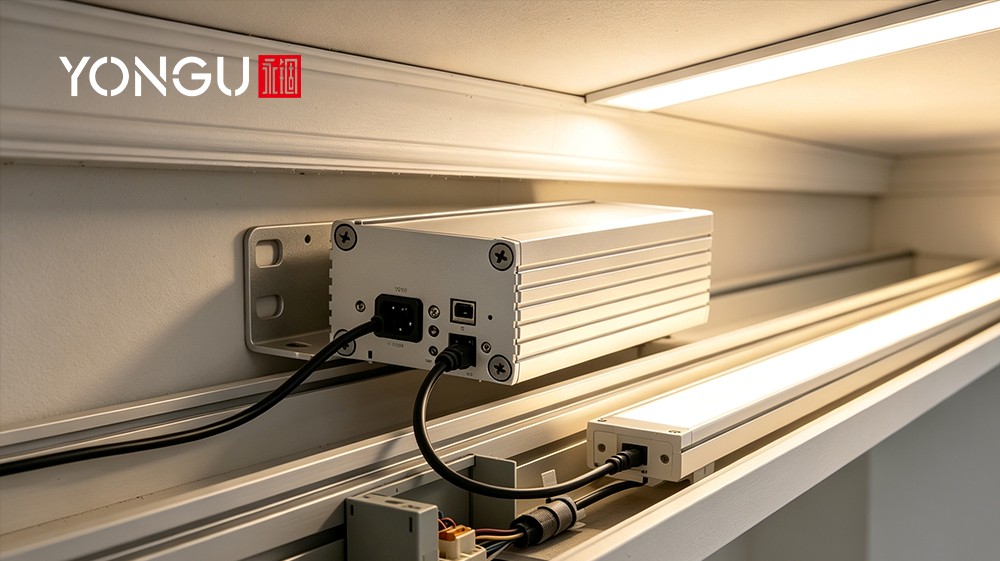
The defining technical advantage of an extruded aluminum enclosure is the internal geometry created during the manufacturing process. Because the metal is pushed through a highly precise die, manufacturers can include continuous grooved tracks along the inner walls. Engineers can simply slide the bare PCB directly into these integrated slots. This eliminates the need to drill mounting holes in the circuit board, source spacer standoffs, or manually drive screws into the chassis interior, drastically reducing mass-assembly time and mitigating mechanical stress on the board.
2. Absolute EMI/RFI Faraday Shielding
Unlike folded metal enclosures fastened with screws, a one-piece extruded chassis features a continuous, unbroken perimeter. This seamless metal ring creates a highly effective Faraday cage. When paired with tightly fastened front and rear end-panels (and optional conductive gaskets), an aluminum PCB housing completely blocks out external electromagnetic interference while trapping any high-frequency noise generated by your own board. This is an absolute necessity for achieving FCC or CE compliance in wireless communication devices and sensitive diagnostic tools.
3. Massive Passive Thermal Capacity
Aluminum boasts a highly efficient thermal conductivity rate. In an extruded design, the entire housing body acts as an active heat sink. Heat generated by power amplifiers or CPUs is rapidly transferred to the heavy-duty walls of the chassis and dissipated safely into the ambient air. Many profiles are engineered with external fins to maximize surface area, enabling powerful fanless operation that is silent, reliable, and entirely immune to dust circulation.
Bridging Concept and Commercialization with YONGU
Transitioning a functional PCB prototype into a market-ready industrial product requires an enclosure that balances robust protection with custom I/O accessibility. For developers creating compact IoT gateways, remote environmental sensors, or audio amplifiers, modifying off-the-shelf boxes is a slow, error-prone process that ruins aesthetic quality.
To streamline your production pipeline, YONGU provides professional-grade infrastructure designed specifically for hardware integration. For compact electronics, utilizing a custom aluminum extrusion box like the YONGU J02-46-2-29 series transforms deployment. Built as a unified heavy-duty shell, it offers absolute rigidity against heavy impacts.
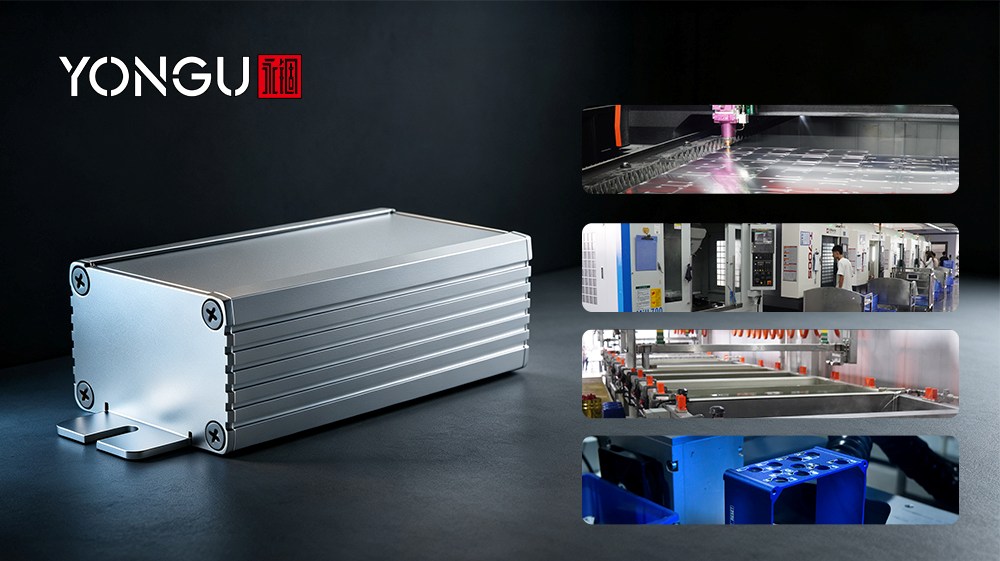
More importantly, YONGU eliminates the customization bottleneck. Since extrusions can be cleanly cut to any specified length, you are never forced to redesign your PCB to fit a rigid box constraint. Paired with YONGU’s in-house CNC machining centers, every port, antenna hole, and ventilation slot is precision-milled before delivery. By applying premium anodic oxidation treatments, the enclosure arrives with superior corrosion resistance and a highly professional, branded finish—ready for immediate, drop-in assembly on your factory floor.
Performance Comparison for PCB Enclosures
To assist hardware developers and procurement teams in visualizing the benefits of extruded aluminum against traditional materials, review the following performance matrix:
| Design Feature | One-Piece Extruded Aluminum | Folded Sheet Metal | Standard Plastic (ABS) |
|---|---|---|---|
| PCB Mounting Method | Integrated slide-in tracks (Fast, zero hardware) | Requires drilled standoffs and screws | Requires internal plastic pillars (Prone to breaking) |
| Thermal Management | Exceptional (Entire body acts as a heatsink) | Moderate (Prone to hotspots) | Poor (Acts as an insulator) |
| EMI/RFI Shielding | Superior (Seamless 360-degree protection) | Good (Vulnerable at corner seams) | None (Requires expensive internal coating) |
| Structural Integrity | High (Resists heavy compression and shock) | Moderate (Can dent or warp easily) | Low (Can crack under impact or cold weather) |
| Length Customization | Extremely Easy (Cut to exact PCB length) | Difficult (Requires entirely new tooling) | Impossible without new molds |
Frequently Asked Questions (FAQ)
Q1: Why are the built-in slots in an extruded housing better than standard standoffs?
A: Internal slots allow the PCB to slide in securely along the edges, preventing flex in the center of the board. It eliminates the need for screws, thereby reducing assembly labor, preventing metal shavings from stripped screws, and providing superior resistance against heavy operational vibrations.
Q2: If my PCB uses Wi-Fi or Bluetooth, will the aluminum enclosure block the signal?
A: Yes, an aluminum enclosure will block wireless signals due to its Faraday cage properties. To resolve this, precision CNC machining is used to cut precise openings for external SMA antenna connectors, or specific RF-transparent plastic end-panels can be utilized while retaining the aluminum body for thermal cooling.
Q3: How does the length customization of an extruded box work?
A: Extruded aluminum is manufactured in long continuous bars. Manufacturers can saw these profiles to your exact specified millimeter. If your PCB is uniquely shaped or unusually long, the extrusion is simply cut to accommodate it without any new molding fees.
Ready to House Your Next PCB Project?
Do not compromise your hardware's reliability with subpar plastics or inefficient sheet metal. Secure your advanced circuitry with precision-machined, thermally superior, and perfectly sized extruded aluminum enclosures designed to thrive in any environment.