Content Menu
● 1. The Hard Standards for an Expert Supplier
>> Full-Chain Production Loop: From Design to Anodization
>> Digital JIT (Just-In-Time) Response Speed
>> Compliance and Industry-Specific Protection
● 2. Supplier Model Overview: A Comparison Table
● 3. Deep Scenario Analysis: The Hidden Risk of "Outsourced Oxidation"
● 4. Scenario-Based Recommendations: Choosing the Right Integration
● 5. Expert Inquiry Guide: How to Expedite Your Project
>> Provide Comprehensive Technical Data
>> Risk Reversal and Commitments
When searching for a global supplier of custom aluminum enclosures, many procurement managers and R&D engineers are often trapped in a cycle of price-only comparisons. On the surface, if you provide a drawing, any factory seems capable. However, the true "cost of ownership" often reveals itself in the form of 3-week delays for samples that should have taken 3 days, severe color inconsistency in anodized batches, or even thermal design failures that put expensive internal electronics at risk. These hidden rework costs are invariably more expensive than the initial savings on unit price.
This guide moves beyond superficial rankings. Instead, we look from the perspective of deep supply chain management to break down how to evaluate a partner that can actually deliver on global standards.
1. The Hard Standards for an Expert Supplier
If you are screening potential partners, you must demand proof of the following capabilities. Without these, even the lowest quote cannot support high-standard industrial projects:
Full-Chain Production Loop: From Design to Anodization
Many suppliers only possess CNC machining capabilities and must outsource surface treatments. This model carries a high risk of "accountability gaps": when the oxidation layer peels or dimensions are off-base, the machining shop and the oxidation plant often blame each other. A qualified global supplier should have a complete closed-loop from product design and material sizing to precision machining and in-house surface treatment (sandblasting, drawing, and anodizing). For instance, a manufacturing base equipped with a fully digital automatic oxidation line ensures that every product remains under a single, unified quality management system.
Digital JIT (Just-In-Time) Response Speed
In the R&D phase, speed is life. While traditional factories might take 5-7 days for a sample, a top-tier flexible production system should achieve 24-hour sample shipment. This requires a high degree of digital operation, where secondary design schemes are completed within 30 minutes and instantly fed into the production sequence.
Compliance and Industry-Specific Protection
An aluminum enclosure is more than just a "box"; it is a functional component. For industries like medical, power, or telecom, the supplier must demonstrate mastery over EMC shielding effectiveness, IP68 waterproof ratings, and corrosion resistance in extreme environments. Ensuring the supplier holds high-tech enterprise certifications is a baseline for reliability.
2. Supplier Model Overview: A Comparison Table
| Dimension | Trade Companies | Single-Process Workshops | Full-Process Source Factory (Yonggu Model) |
|---|---|---|---|
| Price Structure | High hidden commissions | Extremely low initial unit price | Transparent source pricing |
| Technical Support | Communication relay only | No DFM (Design for Mfg) advice | 30-min secondary design; R&D synergy |
| Delivery Stability | Controlled by third parties | Frequent delays due to outsourcing | JIT production; 24-hour sampling |
| Quality Control | Low visibility | Batch-to-batch inconsistency | Unified QC across all processes |
3. Deep Scenario Analysis: The Hidden Risk of "Outsourced Oxidation"
A common mistake in procuring custom aluminum enclosures is underestimating the complexity of surface treatment. Small workshops often outsource anodization to save on environmental compliance costs. The result? You might receive a perfect sample, but the mass production batch arrives with "zebra stripes" or color variations between the front panel and the main body.
A professional source factory, like Yonggu, eliminates this by integrating a 12,000-square-meter manufacturing base with over 160 units of digital CNC equipment and an in-house automatic oxidation line. By keeping the chemistry and the machining under one roof, the "color matching" problem is solved at the source. This is critical for high-end audio, medical testers, and industrial control systems where brand aesthetics are as important as structural integrity.
4. Scenario-Based Recommendations: Choosing the Right Integration
Your choice should depend on your project requirements:
• For Low-End, Non-Standard Parts: A local single-process shop may suffice if precision and surface finish are not priorities.
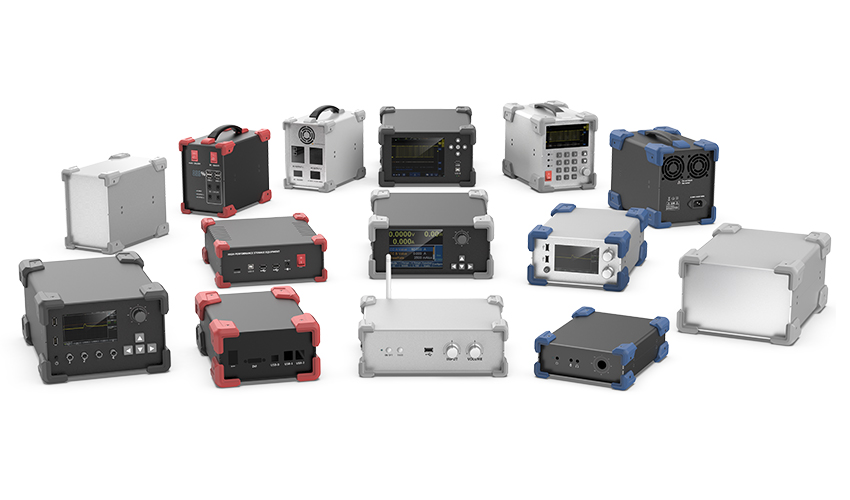
• For High-Requirement Projects (Medical, Industrial, Telecom): You must choose a "Design + Production Integrated" model. For example, in a recent project for an electrical control device, the customer required 6063/5052 aluminum profiles with a dual-finish of moon silver drawing and jade blue sandblasting. Only a supplier with a complete supply chain can ensure that such complex secondary designs are executed without fitting errors between the 19-inch rack-mount chassis and the internal components.[Insert Image: A high-quality photo of a customized D09 series chassis showing precision CNC cutouts and premium anodized finish]
5. Expert Inquiry Guide: How to Expedite Your Project
To get an accurate and fast quote from a global supplier of custom aluminum enclosures, follow these steps:
Provide Comprehensive Technical Data
Send 3D drawings (STEP/IGES format) along with a basic BOM (Bill of Materials). If you only have a concept, find a supplier that offers "Industrial Design" services to help you move from a sketch to a functional prototype.
Request a DFM Evaluation
A "cheap" design that is hard to manufacture will cost you more later. Ask your supplier for a free DFM (Design for Manufacturing) evaluation. Professional engineers should be able to suggest 30-minute adjustments to your secondary design to optimize heat dissipation and reduce machining time.
Risk Reversal and Commitments
To lower the risk of international cooperation, ensure your partner can provide:
• Signed Non-Disclosure Agreements (NDA) to protect your IP.• A "Quality Guarantee": For instance, Yonggu offers a commitment where if the first sample does not meet the agreed specs, the cost is covered.
• One-piece minimum order quantity (MOQ) to support your prototyping phase without heavy financial burden.
Selecting the right global supplier of custom aluminum enclosures is about finding a partner that understands that your enclosure is the first thing your customer sees and the last line of defense for your electronics. By focusing on full-process transparency and JIT digital efficiency, you can ensure your project launches on time and under budget.