I recently helped a client deploy a high-density 5G dual-band industrial IoT gateway project. When setting up telecom hardware in harsh, exposed environments, finding a truly reliable Waterproof Aluminum Enclosure Outdoor is always the team's biggest headache during the early R&D phase. Engineers working on outdoor communications know the drill: once a device is strapped to a utility pole or a transmission tower, it faces a relentless onslaught of torrential rain, UV degradation, and the massive thermal load generated by high-compute network chips. Today, I am going to use the freshly finalized design renders of our "YL-2000 5G" gateway series to break down the lethal pain points of outdoor deployments and how we structurally resolved them.
Conquering Environmental Hazards: The Structural Defense of a Waterproof Aluminum Enclosure Outdoor
The very first hurdle for any outdoor electronics deployment is achieving absolute resistance against water ingress and mechanical vibration. Take a look at the first image, where the unit is mounted to a black cylindrical pole using heavy-duty metal straps. In this specific pole-mounted scenario, the continuous micro-vibrations caused by wind loads put extreme stress on the structural rigidity of the chassis.
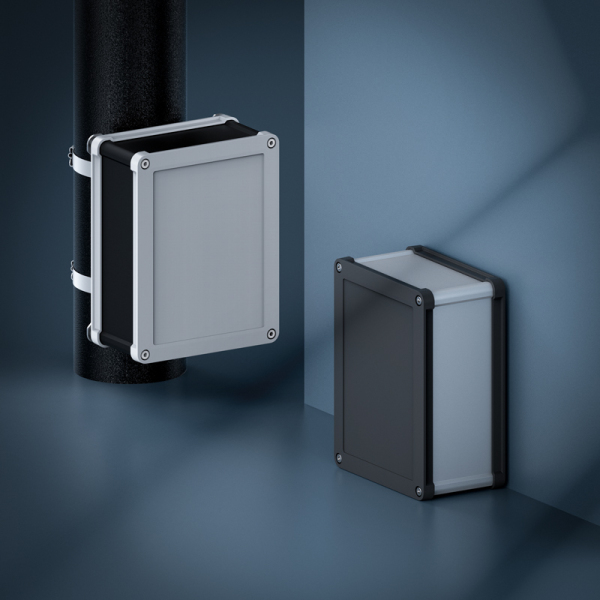
We completely abandoned fragile engineering plastics for this build. If you look closely at the side profiles of the chassis, you will notice the thick, contrasting black corner frames. This isn't just a dual-tone aesthetic choice. These reinforced corner blocks, secured by long hex socket screws, generate an incredibly high and uniform mechanical pre-tightening force. This pressure clamps the front and rear panels dead tight against the main silver extruded aluminum body. By precisely compressing the internal custom silicone sealing rings, this mechanical sandwich structure guarantees a true IP68 rating. Even under severe wind vibrations, there is zero flex, ensuring no moisture can creep into the sensitive PCB inside.
Thermal Throttling and Custom I/O: The Machining Precision Challenge
The second major pain point is managing internal heat accumulation alongside complex I/O requirements. Look at the lower unit lying flat in the second image. 5G networking modules generate a massive amount of heat under heavy data loads. If that heat is trapped, the system will thermally throttle or crash entirely. Here, the heavy-gauge aluminum extrusion acts as a massive passive heatsink. It draws heat directly from the board components and dissipates it through the outer surface area into the natural airflow.
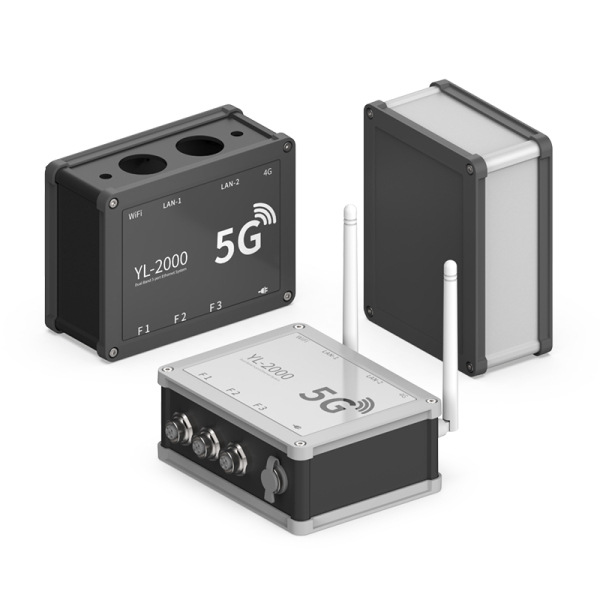
Now, pay attention to the I/O interface on that same unit. It features multiple heavy-duty circular aviation connectors (likely M12 or M16 standard) alongside standard Wi-Fi and 5G antenna mounts. Machining these circular cutouts is notoriously tricky. If the CNC milling tolerances are off by even a fraction of a millimeter, or if the anti-rotation flats aren't cut perfectly, the waterproof gaskets on the connectors will fail. You can see the impeccable edge work around those metal circular plugs and the rubber waterproof cap at the end. The precision here is non-negotiable for an outdoor survival rating.
Agile Deployment: Defeating Insane NRE Costs with Smart Sourcing
Hardware project managers seeing these renders might immediately panic about the budget: "Fully custom CNC machining and custom extrusions for a waterproof enclosure? The tooling costs will be astronomical, and we'll be waiting two months just for the first functional prototype."
Here is the reality check and the secret to our agile deployment: the core skeletal structure of this gateway isn't a ground-up custom mold. It is built entirely upon the proven foundation of the Yongu L series L04B model standard enclosure.
By leveraging an off-the-shelf, standard IP68 aluminum extrusion specifically designed for harsh environments, we completely bypassed the expensive and time-consuming tooling phase. Our engineering efforts were purely focused on the value-added non-standard customizations: the precise CNC drilling for the antenna and aviation plug layouts, the sleek silver-and-black anodized surface treatment, and the crisp UV printing for the "5G YL-2000" interface labeling. Utilizing Yonggu's standard-plus-custom service model allowed us to rapidly prototype and lock in our BOM costs. It proves that you don't need to reinvent the wheel to deliver a rugged, premium-looking industrial device—you just need a highly reliable foundational shell and a smart customization strategy.