An enclosure that passes IEC 60529 at IP66 is not automatically acceptable on a North American project. The authority having jurisdiction in the United States, Canada and Mexico looks for a UL or CSA Type designation — Type 4, Type 4X, Type 12 — and that designation comes from UL 50E. The two systems answer different questions, and understanding the difference is the fastest way to avoid a rejected submittal or a re-test three months before shipment.
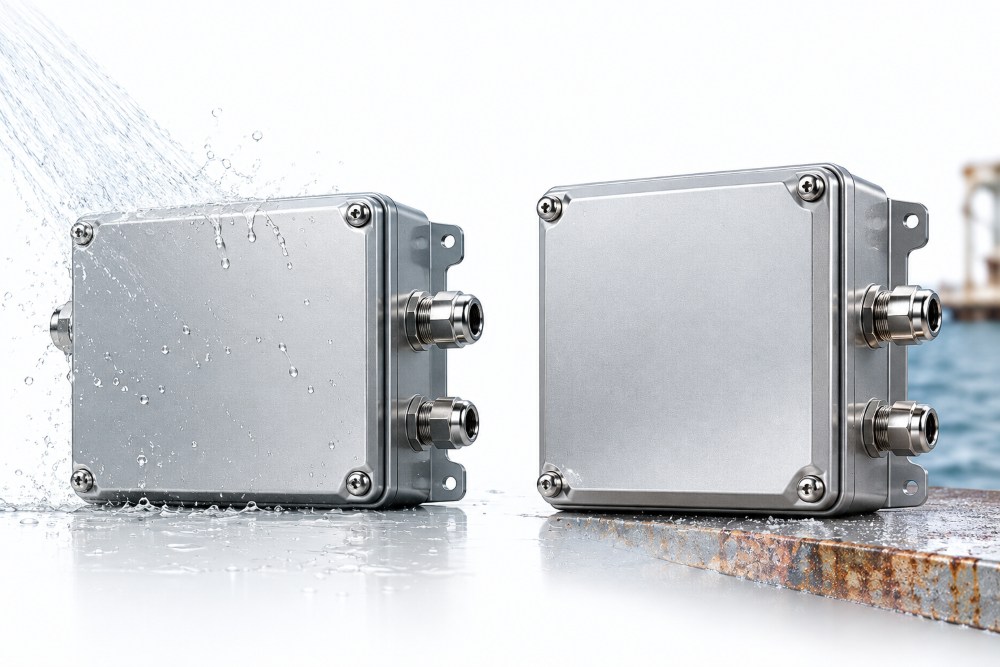
This article explains where UL 50E sits in the North American standards structure, what each Type designation commits you to, which construction details the standard actually drives, and how to design an aluminum enclosure for evaluation rather than discovery.
Where UL 50E Sits in the North American System
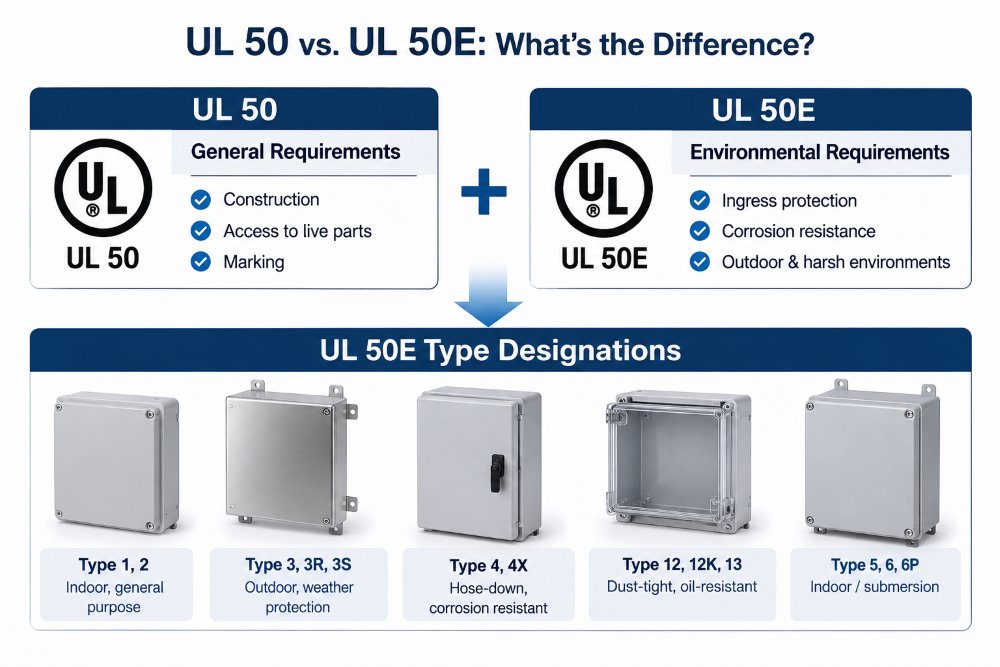
UL 50E is titled Enclosures for Electrical Equipment, Environmental Considerations. It is the companion to UL 50, which carries the general, non-environmental requirements — construction, access to live parts, and marking. When UL 50 was revised to its thirteenth edition, the environmental requirements were split out into UL 50E so that environmental performance could be revised and referenced independently.
Three facts about the current document matter when you are specifying or certifying (UL 50E, UL Standards catalog):
- Edition 3 is the active edition. It was published on 15 October 2020, superseding the 2015 edition, was ANSI-approved on 30 April 2024, and carries a latest revision dated 17 October 2025 in UL's catalog.
- It is a trinational harmonized standard. UL 50E, CSA C22.2 No. 94.2 and NMX-J-235/2-ANCE are published as equivalent documents, which is why one design can be certified for the US, Canada and Mexico without three separate evaluations.
- It is not an IEC standard. The harmonized edition uses the IEC format but is explicitly not based on an IEC standard and is not considered equivalent to one (CSA Group publication notice). An IP rating does not substitute for a Type rating.
The scope is defined by installation code rather than by product category: enclosures for non-hazardous locations installed under the Canadian Electrical Code Part I, NFPA 70 (NEC), and Mexico's NOM-001-SEDE. Type designations divide into indoor types — 1, 2, 5, 12, 12K and 13 — and types rated for indoor or outdoor use — 3, 3X, 3R, 3RX, 3S, 3SX, 4, 4X, 6 and 6P.
What a Type Designation Actually Commits You To
A Type number is not a single test result. It is a bundle of environmental conditions that the enclosure must survive as a system: the housing, the gasket, the flange, the hinges, the fasteners and the marking.
| Type | Environment covered | Typical application |
|---|---|---|
| 1, 2 | Indoor, general purpose; falling dirt and incidental contact, drip protection on Type 2 | Plant rooms, dry process areas |
| 5, 12, 12K, 13 | Indoor, dust-tight; 12 and 12K add drip and oil resistance, 13 adds oil-tight | Machine tools, coolant and lubrication zones |
| 3, 3R, 3S | Outdoor, rain, snow and sleet, ice formation; 3S adds windblown dust and operation of external mechanisms when iced | Pole-mounted and yard equipment |
| 4, 4X | Outdoor, hose-down water plus rain, snow, sleet and windblown dust; 4X adds corrosion resistance | Food, beverage, wastewater, coastal washdown |
| 6, 6P | Temporary submersion (6) and prolonged submersion (6P) | Sump and pit installations, flood-prone vaults |
The trailing X is doing real work. It is the corrosion-resistance suffix, and it is the one most often chosen for a coastal or washdown site without the design following through: a Type 4X aluminum enclosure needs a finish system that survives the standard's corrosion exposure, and needs its fasteners, hinges and external hardware to survive it too. Paint on the body with bare steel screws in the flange is not a Type 4X design.
What UL 50E Does Not Cover
Section 1.3 of the scope is unusually blunt, and it is worth quoting in a design review: the standard does not cover protection of devices against conditions such as condensation, icing, corrosion, or contamination that may occur within the enclosure, or that may enter via conduit or unsealed openings.
That sentence is a list of design decisions left to you. A sealed Type 4 enclosure still condenses on the inside when the internal air cools after a warm day, and the Type rating will not protect the electronics from it. Conduit that enters through an unfilled raceway is an unsealed opening by definition. If the application needs pressure equalisation, a breather membrane, a desiccant or a drain, that is the designer's responsibility, and it must be added without breaking the Type rating you are claiming.
A second clause matters commercially: where an individual product standard contains requirements at variance with UL 50E, the product standard takes precedence. A photovoltaic or a fire-pump controller enclosure may therefore carry additional requirements layered on top of the Type designation.
UL 50E Versus IEC 60529: Use Both, Convert Neither
The two standards are often presented as cross-reference tables, and that presentation is the source of most specification errors. They are not convertible.
- IEC 60529 classifies ingress protection with two digits — solids first, water second — and defines the test conditions for each digit. It says nothing about corrosion resistance, ice formation, or the installation code the product must satisfy.
- UL 50E assigns a Type designation tied to the North American installation codes, and bundles environmental construction requirements with the performance tests. It uses the IEC document format but states plainly that it is not equivalent.
In practice a designer often needs both: a Type 4X designation for the North American submittal, and an IP rating for the European or Asian datasheet. The correct approach is to design to the stricter construction and test both, not to compute one from the other. Claims that a given Type "equals" a given IP number circulate widely; certification bodies do not accept them as evidence. Note also that impact resistance is not part of the IP two-digit code — mechanical impact is specified separately in IEC 62262 as an IK rating.
Which Construction Details the Standard Drives
UL 50E is a performance standard, but the failures it catches are construction failures. Five details decide the outcome on an aluminum enclosure.
- Flange stiffness and gasket load. A hose-down test is a water-pressure test on a joint. If the lid flange bows between fasteners, the gasket unloads at mid-span and water finds the gap. Machined flanges with adequate section depth, and fastener pitch held around 60 to 80 mm, keep the load even. Sealing groove depth held to ±0.05 mm keeps gasket compression inside its working range instead of at its limit.
- Corrosion system for X ratings. Anodizing gives a hard insulating oxide; chromate conversion preserves electrical bonding; powder coating gives the thickest barrier but must be applied over a proper pretreatment. Whichever is chosen, external hardware has to match it, and dissimilar-metal contact needs isolation.
- Openings, conduit and drains. Every entry is part of the enclosure for rating purposes. Glands must be rated for the cable, unused positions need blanking plugs, and any breather must be placed where it never faces the water source.
- External mechanisms. Types 3S, 4 and 4X address operation of external mechanisms under ice or water. A latch that cannot be worked with a gloved hand after an ice storm fails the intent of the rating even if the sheet metal passes.
- Marking. The Type designation has to appear on the product. Plan the label, the laser mark or the cast-in plate at the same time as the layout, not after the finish is applied.
Preparing an Aluminum Enclosure for Evaluation
Pre-compliance work is cheaper than a failed submittal. Before sending samples, confirm the gasket groove and flange flatness with a CMM rather than a sample check; verify that the finish system has a salt-spray result appropriate to the X suffix you intend to claim; assemble production-intent fasteners and glands, since evaluation hardware that differs from production is a common cause of discrepancy; and confirm which product standard, if any, layers additional requirements onto the Type rating.
It also helps to decide early which Type you are actually claiming. Type 4 and Type 4X are often quoted interchangeably in enquiries, and the difference is a corrosion qualification that changes the finish, the hardware and the cost. Choosing it at the quotation stage is a five-minute decision; choosing it after tooling is a project delay.
YONGU Electrical Aluminum Enclosures
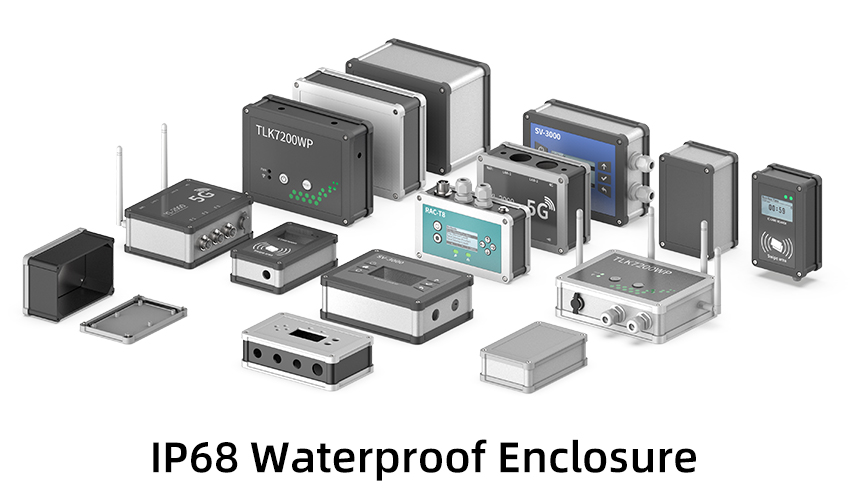
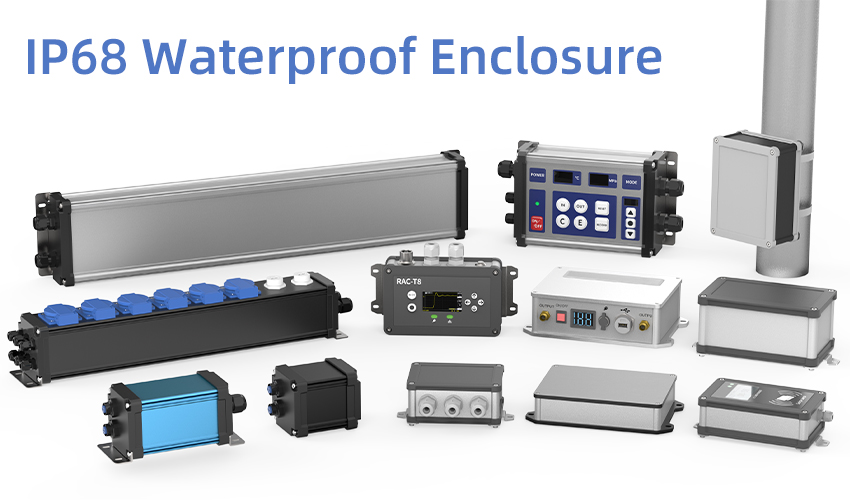
YONGU builds machined aluminum enclosures for instrument, control and power applications. The IP67 aluminum enclosure range covers sealed field housings with machined sealing faces and gland-ready end walls, and the IP68 waterproof range extends to immersion-rated units tested by Bureau Veritas to IEC 60529 at 1.5 m, with reports on the downloads page. Bodies are produced in 6061 and 6063 aluminum on custom CNC machining, with anodizing, chromate conversion or powder coating available according to the corrosion class the project targets. For background on how Type numbers relate to the wider North American system, see what is a NEMA enclosure; general questions are answered on the FAQ page.
UL 50E FAQ
Is UL 50E the same as NEMA 250?
No, they are separate documents, although the Type designations they describe are aligned by long-standing industry practice. UL 50E is the UL and CSA harmonized standard used for certification; NEMA 250 is the manufacturers' association standard that defines the same type numbers.
Does an IP68 enclosure pass UL 50E automatically?
No. UL 50E states that it is not equivalent to an IEC standard. An IP rating can support part of the evidence, but the Type designation is granted after UL 50E evaluation, including construction and corrosion requirements that the IP code does not address.
What is the difference between Type 4 and Type 4X?
Type 4 covers hose-down water, rain, snow, sleet, windblown dust and external ice formation. Type 4X adds corrosion resistance, which drives the finish system and the external hardware selection.
Does UL 50E cover condensation inside the enclosure?
No, and the scope says so explicitly. Condensation, icing, corrosion and contamination inside the housing, or entering through conduit or unsealed openings, are outside the standard and remain a design responsibility.
Can one design be certified for the US, Canada and Mexico together?
Yes. UL 50E, CSA C22.2 No. 94.2 and NMX-J-235/2-ANCE are published as equivalent harmonized documents, so a single evaluation can support all three markets.
References
UL 50E, Enclosures for Electrical Equipment, Environmental Considerations, Edition 3, published 15 October 2020, ANSI-approved 30 April 2024, latest revision 17 October 2025 (UL Standards catalog). Harmonization and the non-equivalence statement to IEC follow the CSA Group publication notice for CSA C22.2 No. 94.2:20 / UL 50E. Ingress protection definitions referenced above are from IEC 60529; mechanical impact ratings from IEC 62262. Product tolerances and immersion reports referenced above are published on yg-enclosure.com.