Hydrology and water quality testing work often takes place in complex outdoor environments characterized by high humidity, water exposure, and sediment. As the protective core of testing equipment, the corrosion resistance, structural stability, and dimensional accuracy of the instrument enclosure directly determine the lifespan and operational reliability of the device. Custom instrument enclosures can be precisely engineered to match the functional requirements and application scenarios of water testing equipment. Due to its lightweight nature, excellent corrosion resistance, and high machinability, aluminum alloy has become the preferred material for manufacturing water testing instrument enclosures. This article will break down a custom aluminum alloy enclosure project designed for hydrology testing instruments, detailing parameter design, machining processes, material selection, and core advantages, providing a professional guide for your B2B enclosure customization needs.
Core Overview of the Custom Enclosure Project
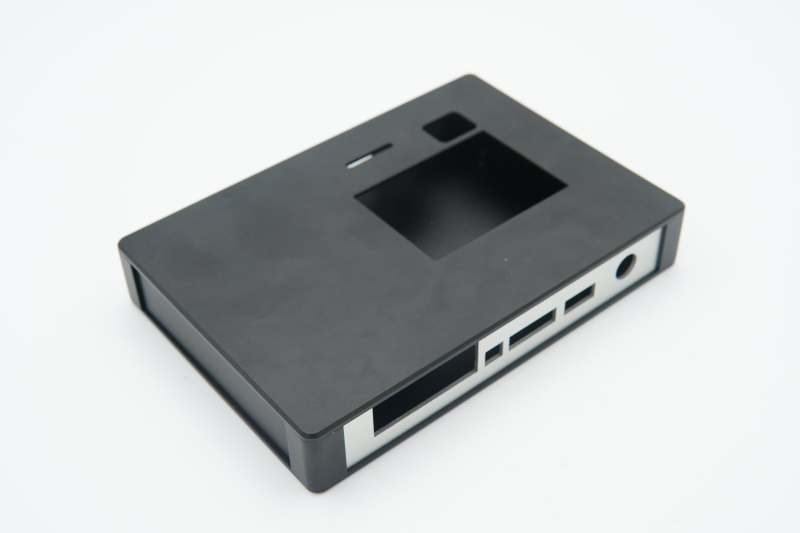
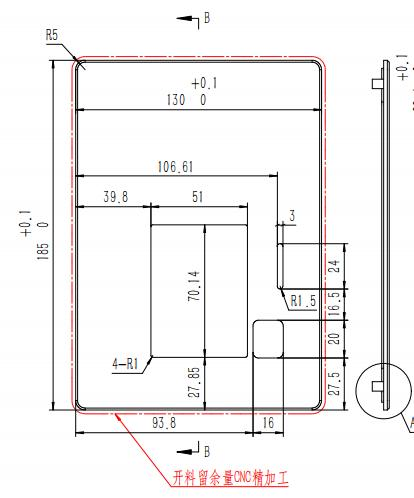
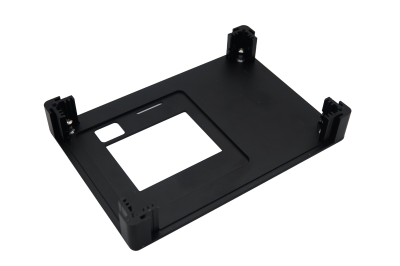
This custom water testing instrument enclosure project was tailored specifically for hydrology testing equipment, perfectly aligning with the all-weather requirements of outdoor field operations. From model selection and dimensional customization to material choice and surface treatments, every detail was engineered around the anti-corrosion, moisture-proof, and structural stability demands of marine and aquatic environments. Based on the standard N203A model, the overall dimensions of this custom enclosure are 185*31*130mm. The core structural components are fabricated from premium 6063 and 5052 aluminum profiles. The surface undergoes an anodizing process and is available in two localized finishes: Sandblasted Obsidian Black and Sandblasted Moonlight Silver. During the cutting phase, machining allowances were strategically reserved to facilitate CNC precision machining, ensuring dimensional tolerances are strictly controlled within ±0.1mm. This guarantees a seamless fit between the housing and the internal electronic components, providing 360-degree protection and structural support for the testing device.
Detailed Specifications of Core Components
| Component Category | Component Name | Dimensions (mm) | Material Info | Surface Treatment | Machining Processes |
|---|---|---|---|---|---|
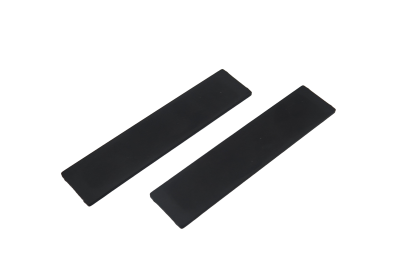
| Cover Panel Assembly | Cover Panel A | 185×130×4 | 5052-H32 | Sandblasted Obsidian Black | CNC → Chamfering → Riveting → Deburring → Sandblasting → Anodizing → Packaging |
| Cover Panel Assembly | Cover Panel B | 185×130×3 | 5052-H32 | Sandblasted Obsidian Black | CNC → Riveting → Deburring → Sandblasting → Anodizing → Packaging |
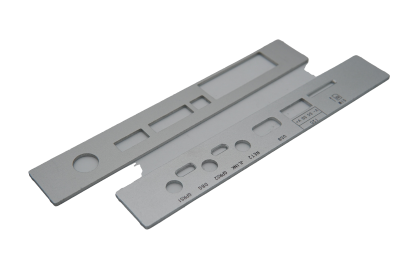
| Baffle Assembly | Baffle A | 167×25×2 | 5052-H32 | Sandblasted Moonlight Silver + UV Printing | Laser Cutting → CNC → Deburring → Sandblasting → Anodizing → UV Printing → Packaging |
| Baffle Assembly | Baffle B | 167×25×2 | 5052-H32 | Sandblasted Moonlight Silver | Laser Cutting → Deburring → Sandblasting → Anodizing → Packaging |
| Left/Right Baffles | Side Baffles | 112×25×2 | 5052-H32 | Sandblasted Obsidian Black | Laser Cutting → Deburring → Sandblasting → Anodizing → Packaging |
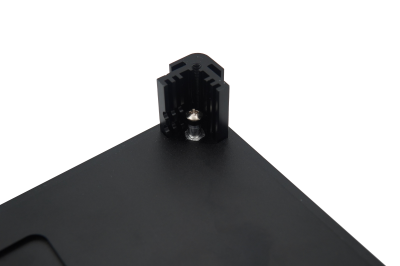
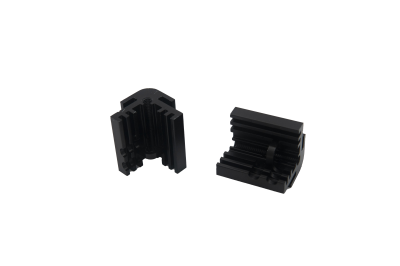
| Support Assembly | Mounting Pillar | 25×22×13 | 6063-T5 | Sandblasted Obsidian Black | Sawing → CNC → Tapping → Sandblasting → Anodizing → Packaging |
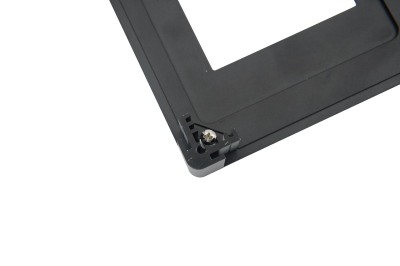
| Fasteners | Nickel-Plated Carbon Steel Phillips Countersunk Screws | M4×8 | Standard Carbon Steel | / | / |
| Fasteners | Nickel-Plated Carbon Steel Phillips Truss Head Screws | M3×6 | Standard Carbon Steel | / | / |
 |
 |
 |
 |
 |
 |
In-Depth Analysis of Core Machining Processes
Based on the functional positioning and operational requirements of each structural part, our custom enclosure manufacturing utilizes highly differentiated precision machining workflows. Striking the perfect balance between machining accuracy, structural rigidity, and corrosion resistance, every step is optimized for outdoor aquatic environments, ensuring premium quality control.
Pillar Machining Process: As the core structural support of the enclosure, the mounting pillars are precisely cut using a sawing process and then shaped via CNC precision machining. A subsequent tapping process prepares high-precision threaded holes for assembly, ensuring structural integrity. The final sandblasting and anodizing processes not only enhance anti-corrosion and scratch-resistant properties but also visually unify the surface texture with other components, making it highly resilient to bumps and moisture in field applications.
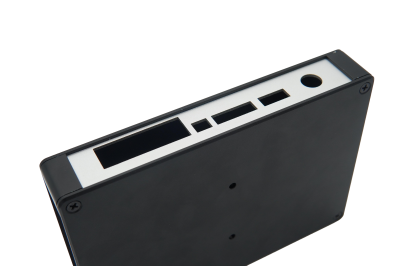
Cover Panel Machining Process: Cover panels A and B achieve strict dimensional accuracy through CNC precision machining. Panel A undergoes an additional chamfering process to eliminate sharp edges, enhancing handling safety. The press riveting process fortifies the connection points, entirely eliminating the risk of components loosening due to operational vibrations. The closed-loop process of deburring, sandblasting, and anodizing creates a dense protective layer that effectively repels water vapor and sediment intrusion.
Baffle Machining Process: The baffles are primarily manufactured using laser cutting technology, enabling high-precision fabrication of irregular shapes and I/O cutouts. The hole deviation is strictly controlled within 0.05mm, ensuring a flawless fit with all instrument interfaces. Baffle A is further refined through CNC machining and UV printing, which accommodates custom brand logos, serial numbers, and equipment parameters. All baffles undergo thorough deburring and anodizing, dramatically extending their durability and weather resistance.
Professional Considerations in Material Selection
This custom testing instrument enclosure mainly utilizes 5052-H32 and 6063-T5 aluminum profiles, paired with high-quality nickel-plated carbon steel fasteners. This combination is the result of rigorous engineering assessments regarding high-humidity outdoor environments, functional demands, and mechanical stability.
The 5052-H32 aluminum profile is the core material for the cover panels and baffles. As an Al-Mg alloy containing 2.2%-2.8% magnesium, it naturally forms a dense oxide layer on its surface. Its salt spray corrosion resistance exceeds 480 hours, effectively preventing rust caused by water vapor, mud, and splashing. Furthermore, with a tensile strength ranging from 170 to 305 MPa, it offers superior impact resistance against outdoor collisions without deformation. Its excellent formability allows for seamless laser cutting, CNC, and riveting.
The 6063-T5 aluminum profile is specifically utilized for the support pillars. It boasts remarkable structural strength and form retention, providing a rugged structural framework for the instrument housing. Its top-tier anodizing capabilities ensure a uniform oxide film post-sandblasting. Weighing only one-third as much as standard steel, it drastically reduces the overall weight of the testing device, making it much easier for technicians to carry into the field.
The companion fasteners are nickel-plated carbon steel screws. The nickel plating isolates water vapor and oxygen, preventing the screws from rusting and subsequently loosening in wet conditions. The M4×8 and M3×6 specifications perfectly match the fastening requirements of different components, rendering the overall assembly extraordinarily robust.
Core Challenges Solved by Enclosure Customization
This custom instrument enclosure project addresses four core pain points commonly encountered during outdoor hydrology testing, serving as a reliable hardware guard for your equipment. The technical benefits are clearly demonstrated by the following metrics:
- 1. Resolving Insufficient Corrosion Resistance: Standard plastic or untreated metal housings typically exhibit rust and degradation within 24 hours of salt spray testing, resulting in a lifespan of less than 6 months. Our anodized and sandblasted custom aluminum housings boost corrosion resistance by 20 times. Surviving over 480 hours of salt spray testing with zero corrosion or peeling, they extend the equipment's field lifespan to over 5 years.
- 2. Overcoming Low Dimensional Accuracy: Traditional enclosures suffer from poor machining precision (tolerances up to ±0.5mm), leading to assembly gaps, equipment rattling, and a testing data error rate as high as 8%. Through precision CNC machining, our custom enclosures maintain strict tolerances of ±0.1mm. This achieves a "gapless fit," dropping operational vibrations by 70% and keeping data error rates strictly under 1%.
- 3. Reinforcing Structural Impact Resistance: Generic enclosures often feature simplistic designs resulting in a 30% damage rate from drops and bumps in the field. Our custom enclosures employ application-specific structural engineering—reinforced pillars and thickened baffles—enhancing overall impact resistance by 40%. The housing withstands 1-meter drops without structural deformation or cracking, maintaining an equipment integrity rate of 98%.
- 4. Preventing Component Loosening: Substandard connection structures in traditional housings easily vibrate loose during transport, causing a 45% equipment failure rate. By combining press riveting, high-precision tapping, and nickel-plated carbon steel screws, connection stability is boosted by 60%. It remains securely intact through long-term outdoor usage, slashing the hardware failure rate to below 8%.
The Business Value of Custom Aluminum Enclosures
Investing in professional testing instrument enclosure customization goes beyond hardware protection. It directly translates to immense commercial value in equipment operation, manufacturing assembly, and global market competitiveness:
- 1. Upgraded End-User Experience: Enhanced corrosion resistance, structural robustness, and precision enable the equipment to effortlessly operate in demanding scenarios such as rivers, dams, and hydrological stations. Outdoor operational stability is improved by 65%, while field operational efficiency jumps by 40%.
- 2. Optimized Production & Assembly Efficiency: Emphasizing standardized and modular design, the custom enclosure components are perfectly synchronized. Batch assembly efficiency is elevated by 45%, reducing the assembly time per unit by 18 minutes, thus significantly cutting direct labor costs.
- 3. Drastically Reduced After-Sales Costs: Superior impact resistance and anti-corrosion features inherently lower malfunction rates. Warranty return rates are reduced by 35%, and general after-sales maintenance expenses fall by 28%, maximizing client satisfaction.
- 4. Surging Market Competitiveness: The premium aesthetics, rugged performance, and steadfast reliability of the customized aluminum housing place the product far above off-the-shelf alternatives. Brand recognition is increased by 50%, with post-launch quarterly sales jumping by 32% and channel repurchase rates rising by 25%.
Our Professional Enclosure Customization Service Advantages
Catering precisely to the rigorous demands of industrial testing equipment, our instrument enclosure customization services offer an end-to-end B2B solution—spanning requirement analysis, CAD design, material selection, rapid prototyping, and mass production. Our core advantages include:
- Application-Centric Design: Deeply understanding the necessity for high humidity tolerance, impact resistance, and measurement accuracy, we design the physical structure, manufacturing flow, and surface finishes exclusively tailored for testing instrument housings.
- World-Class Precision Machining: Powered by advanced CNC machinery and laser cutting stations, our experienced engineering team achieves industry-leading tolerance control. Pinpoint hole accuracy and strict dimensional consistency guarantee perfect integration with your PCBs and sensors.
- End-to-End Quality Assurance (QA): From sourcing premium raw aluminum extrusions to dispatching the final packaged units, every manufacturing step is subjected to uncompromising quality checks. Focusing on dimensional precision, anti-corrosion metrics, and structural fortitude, we assure total compliance with international industrial standards.
In conclusion, the caliber of the water testing instrument enclosure fundamentally defines the reliability and market success of the device. Professional enclosure customization is the definitive answer to the core hardware challenges faced in harsh field environments. Built around elite 6063 and 5052 aluminum profiles, our lightweight, corrosion-proof, and meticulously machined housings stand as the premier choice for hydrology and industrial testing equipment. Empower your brand with our tailored hardware solutions, enabling highly efficient, accurate, and resilient testing operations globally.