An outdoor IoT enclosure is not chosen by picking the highest IP number on the shelf. It is chosen by four requirements that come from the deployment site itself: how much water and dust the housing must survive, how the metal will corrode in that atmosphere, how the unit will be fixed to a pole or wall, and how the radio and cables will get through a metal wall without opening a path for water. Get those four right and the enclosure lasts a decade. Get one wrong and the device fails in the field, usually in the first wet season, usually in a way that costs more to service than the housing cost to buy.
This guide works through each requirement against IEC 60529 and ends with a deployment matrix and an RFQ checklist.
What an IP Rating Actually Commits You To
IEC 60529 is published as IEC 60529:1989, Edition 2.0, in consolidated form with Amendment 1 (1999) and Amendment 2 (2013) incorporated; the current stability date is 2027, and a third edition is in development at the ACD stage with a forecast publication date of 2027-12-31 (IEC 60529, webstore). The code has two digits: the first covers solids and dust, the second water. For outdoor IoT the first digit is almost always 6, so the decision is about the second digit.
| Rating | Test condition in IEC 60529 | Where it fits outdoors |
|---|---|---|
| IP65 | Dust tight; water jets from a 6.3 mm nozzle at 12.5 L/min for at least 3 minutes | Sheltered wall node, under an eave or inside a cabinet |
| IP66 | Dust tight; powerful jets from a 12.5 mm nozzle at 100 L/min for at least 3 minutes | Exposed pole mount, driving rain, washdown areas |
| IP67 | Dust tight; temporary immersion at 1 m for 30 minutes | Ground-level pits, flood-prone sites, buried junction boxes |
| IP68 | Dust tight; continuous immersion — depth and duration agreed between buyer and manufacturer | Tank-side, submerged sensors, long-duration immersion |
| IP69K | Not defined in IEC 60529; high-pressure, high-temperature washdown is specified in ISO 20653 | Food processing, vehicle washdown — not a substitute for IP68 |
Two consequences follow. First, IP68 has no fixed test condition — depth and duration are agreed between buyer and manufacturer, so an IP68 claim without a stated depth is marketing, not a specification. Second, a higher digit does not cover everything: IP67 and IP68 assume static immersion, while IP66 addresses water at pressure. A coastal pole in wind-driven rain is better served by IP66 with a correctly oriented entry than by an IP68 label.
Requirement 1: Sealing for the Real Exposure
Sealing is a system, not a rating. On an aluminum enclosure it consists of a machined groove, a compressed gasket, a fastener pattern that loads the gasket evenly, and entries that are sealed as carefully as the lid.
- Groove geometry. The groove depth sets gasket compression. For a 2.0 mm O-ring cord, a 1.5 mm groove gives 25 percent compression — the middle of the useful range; 0.1 mm of machining error moves that to 20 or 30 percent, which is why sealing faces are held to ±0.05 mm rather than general tolerance.
- Fastener spacing. Lid screws at 60 to 80 mm pitch keep the gasket under uniform load. Wider spacing lets the lid bow between screws, and the gasket takes a permanent set at the deflection point.
- Pressure cycling. A sealed box that heats and cools creates internal pressure swings. Either the gasket is specified for that cycling, or a breathable pressure-equalization membrane is fitted — which is a deliberate, rated vent, not a hole.
- Condensation. Sealing stops water entering, not moisture already inside from condensing on a cold board; conformal coating or a desiccant addresses that separately.
The L-series and M-series profile enclosures are tested by Bureau Veritas to IEC 60529 at 1.5 m immersion, with the report on the downloads page — the kind of evidence to request from any supplier.
Requirement 2: Corrosion in the Atmosphere You Deploy Into
Aluminum does not rust, but it does corrode, and the rate depends on the chemistry around it. Four failure modes dominate:
- Chloride attack — coastal and offshore sites. Salt deposits break down the passive oxide layer and pit the surface, most aggressively at cut edges and machined corners.
- Galvanic coupling — stainless screws, brass glands and copper cable shields threaded into an aluminum body form a galvanic pair. In wet conditions the aluminum becomes the anode and loses material around the fastener. Isolating washers or a conversion coating on the mating face solve it.
- Ammonia and hydrogen sulfide — livestock buildings, wastewater and some industrial estates. These attack anodized layers that would survive salt spray without difficulty.
- UV and thermal cycling — organic coatings chalk and micro-crack, then hold water against the metal.
For 6061 and 6063 extrusions, anodizing gives a hard, insulating oxide suited to coastal sites; chromate conversion is better where electrical bonding must be maintained; powder coating gives the thickest barrier but needs correct pretreatment or it lifts at cut edges. A 72-hour neutral salt fog test is a reasonable qualification gate — not a lifetime prediction, but enough to separate finishes that fail in year one from those that do not.
Requirement 3: Mounting Load and Orientation
Pole and mast mounting is a structural problem before it is an enclosure problem. A 2 kg gateway on a 3 m bracket in a 40 km/h gust sees repeated bending and vibration, and the housing has to transmit that load into the pole without distorting its own sealing faces.

- Mounting features belong in the extrusion. Integral mounting rails or machined bosses spread the load into the wall rather than into four thin spots. Threaded inserts are preferable to self-tapping screws in aluminum, which work loose under vibration.
- Wall thickness is a sealing parameter. A flange that flexes under screw load opens the groove at its center; adequate section depth keeps compression uniform.
- Orientation decides water entry. Cable entries go at the bottom face, with a drip loop below the gland. A top entry with a perfect IP68 gland still collects a pool of water above the seal.
- Service access. A lid facing the ground is protected but impractical; one facing the sky collects water in the groove. Choose deliberately.
Requirement 4: Connectivity Through a Metal Wall
An aluminum enclosure is a Faraday cage. That is an advantage for EMI and a problem for antennas, and there is no way to solve the antenna problem without making a decision about sealing.
| Approach | Effect on sealing | Best for |
|---|---|---|
| External antenna via bulkhead SMA/N connector | Each penetration is a sealed joint; torque and O-ring quality decide the rating | Long cable runs, directional antennas, high-gain links |
| Hybrid housing: aluminum body, RF-transparent end caps | No antenna holes at all; the joint moves to the end cap gasket | Compact nodes with internal PCB antennas |
| Machined antenna window with a sealed radome insert | One large sealed aperture instead of many small ones | Multi-band gateways needing several antennas in one plane |
| Cable glands (M12, M16) and circular connectors | Sealing depends on the flat and the anti-rotation feature being machined correctly | Power, Ethernet and sensor I/O |
Two details decide whether these joints hold: the anti-rotation flat on a circular connector must be cut to depth or its gasket will not seat; and unused ports need a rated blanking plug, because an open M16 thread is a straight path inside.
Deployment Matrix
| Deployment | Sealing | Corrosion | Mounting | Connectivity |
|---|---|---|---|---|
| Coastal / offshore | IP66 or IP67, 316-grade hardware | Anodized plus sealed cut edges; 72 h salt fog | Thick bracket, isolated fasteners | Sealed bulkhead, bottom entry |
| Urban street pole | IP66, tamper-resistant lid screws | Powder coat for impact and graffiti resistance | Band or clamp mount, integral rails | Hybrid end cap for internal antennas |
| Livestock / wastewater | IP67 minimum, chemical-resistant gasket | Powder coat; avoid exposed anodizing | Wall bracket, high mounting to avoid washdown | Glands plus blanking plugs, bottom entry |
| Desert / high UV | IP65–IP66, UV-stable gasket | UV-stabilized coating, light color to reduce solar load | Shaded orientation, thermal separation from the pole | External antenna, sealed bulkhead |
| Tunnel / underground | IP67, pressure-equalization membrane | Chromate conversion for bonding continuity | DIN or wall rail, vibration-damped | Glands, fiber or Ethernet feed |
| Cold store / freezer | IP67, low-temperature gasket grade | Anodized; no dissimilar-metal contact | Insulated standoff to limit thermal bridging | Sealed connector, heated or drained entry |
RFQ Checklist
Send these nine items to a supplier and most of the specification risk disappears before the first sample:
- The required IP rating, with the second digit justified by the deployment.
- The test standard, test depth and duration, and the name of the testing laboratory.
- A copy of the immersion or jet test report, not a certificate of conformity alone.
- Base alloy and temper (6061-T6 or 6063-T5 for extruded bodies).
- Surface finish and its salt fog qualification, with the hours stated.
- Sealing groove dimensions and the gasket compression percentage.
- Lid fastener pitch, thread type and specified assembly torque.
- Mounting interface: boss geometry, insert type, and the load it is rated for.
- Entry plan for every port: gland size, sealing method, and blanking plug for unused positions.
YONGU Outdoor IoT Enclosure Options
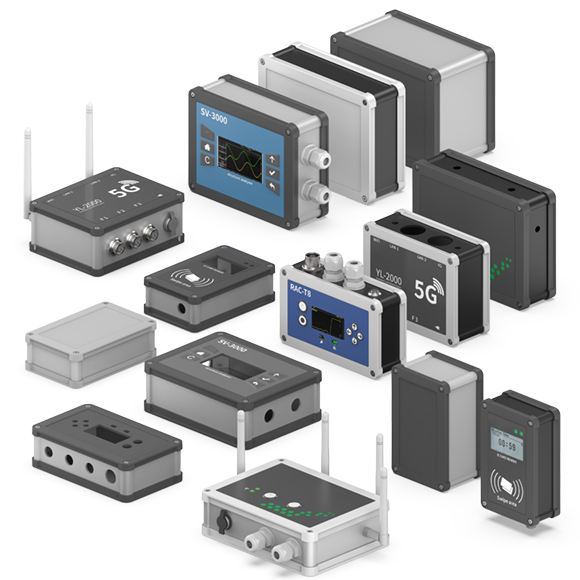
The IP68 waterproof aluminum enclosure range covers sealed bodies from compact sensor housings to gateway-sized units, machined with sealing faces held to ±0.05 mm and tested by Bureau Veritas at 1.5 m immersion. The L-series profile enclosure suits pole-mounted nodes where a split-body extrusion and internal PCB rails simplify assembly, and the MJ03 gateway control box is sized for edge gateways with planned antenna and gland layouts. For single-piece bodies, the M01 unibody enclosure removes the split-line joint entirely. Port layouts, antenna windows and mounting brackets are cut on custom CNC machining across 160+ machines and 14 production lines, with tolerances documented in the capability overview. If the rating question is still open, IP65 vs IP67 for outdoor electronics and understanding IP ratings from IP54 to IP68 cover it from the other direction; general questions are on the FAQ page.
Outdoor IoT Enclosure FAQ
Is IP68 always better than IP66 for an outdoor IoT enclosure?
No. IP68 covers continuous immersion at an agreed depth, while IP66 covers powerful water jets. A pole-mounted node exposed to wind-driven rain may be better specified to IP66 with correct entry orientation than to an IP68 label with no stated test depth.
Why does IP68 need a stated depth?
Because IEC 60529 leaves immersion depth and duration to agreement between buyer and manufacturer. "IP68" alone does not tell you whether the housing was tested at 1 m for 30 minutes or 5 m for 24 hours.
Do aluminum enclosures corrode at the coast?
The base metal forms a passive oxide layer, but chlorides pit it, especially at cut edges. Anodizing or a properly pretreated powder coat plus isolated stainless fasteners is the standard coastal specification.
Will a metal enclosure block the IoT radio?
Yes — aluminum acts as a Faraday cage. The three workable solutions are an external antenna on a sealed bulkhead, a hybrid body with RF-transparent end caps, or a machined window with a sealed radome insert.
How many cable entries can an enclosure take before the IP rating is at risk?
There is no fixed number; each entry is an independent sealed joint. What matters is that every gland is the correct size for its cable, torqued to specification, and that unused positions are closed with rated blanking plugs.
References
IP code definitions and test conditions: IEC 60529:1989 (Edition 2.0, consolidated with AMD1:1999 and AMD2:2013), degrees of protection provided by enclosures, TC 70. Washdown ratings outside the IP code: ISO 20653. Product data, sealing tolerances and test reports referenced above are published on yg-enclosure.com.