An outdoor metal junction box does two jobs that matter more than the box itself: it keeps every cable splice dry and dust-free, and it provides a continuous conductive path for fault current and EMI shielding. Aluminum is the most common metal choice for this duty — light, stiff, anodizable, and naturally weather-resistant — but the rating that protects the splice depends on the alloy, the seal, the gland entries, and the grounding connection, not the label on the lid. This guide covers the outdoor-specific decisions behind an IP65–IP68 aluminum junction box: how the site challenges the housing, how metal compares with plastic, which aluminum grade and finish suit the exposure, and how grounding and bonding are wired to code.
Outdoor Environment Challenges for Junction Boxes
A junction box sits where several cables meet, so it carries more entry points than a sealed sensor housing, and every gland is a potential water path. Outdoor exposure stacks four stresses on the box at once. Rain, fog, and dew keep the exterior wet; sand, dust, and road grit settle on horizontal faces and wash into gaps during storms. Temperature cycling heats the box by day and cools it at night, drawing humid air in and out and driving condensation onto splices. Wind vibration and vehicle-induced shake loosen fasteners over months. In coastal or road-salt locations, salt spray attacks edges, threads, and any scratch through the finish. A junction box that survives this has a continuous seal, drained geometry, corrosion-resistant fasteners, and a grounding path that stays intact through the same cycling. For the broader outdoor protection context, see protecting outdoor electronics with junction boxes.
Metal vs Plastic for Outdoor Junction Boxes
The choice between aluminum and a plastic housing starts with whether the box must carry ground continuity and EMI shielding. Metal provides a rigid housing that does not creep under bolt tension, a continuous conductive body that bonds to the equipment grounding conductor, and a surface that does not yellow or embrittle under UV. Plastic is lighter and cheaper, naturally insulated, but UV-degrades unless stabilized, expands two to three times more than aluminum per degree, and cannot serve as a ground path without an internal grounding bar. Under repeated vibration, threaded inserts can creep or strip — the common failure mode of cheap outdoor plastic boxes.
| Criterion | Aluminum metal box | ABS / polycarbonate box |
| Ground continuity | Body bonded to ground; door bonded with jumper | None; internal grounding bar required |
| Rigidity under bolt load | High; threaded inserts stay loaded | Lower; inserts can creep or strip over time |
| UV stability | Inherent; finish oxidizes rather than chalks | Needs UV stabilizers; ABS yellows and cracks |
| EMI shielding | Inherent when bonded and gasketed | None without conductive coating |
| Weight and cost | Heavier; higher prototype unit cost | Light; lower high-volume cost |
Aluminum Grades for Outdoor Use
Most outdoor junction boxes are built from one of four aluminum forms, and the grade sets what the finish has to do. 6063 is the standard extrusion alloy for profile and bar-style boxes: it anodizes cleanly, bends and extrudes easily, and has the general corrosion resistance expected in normal outdoor air. 6061 offers higher tensile strength for thicker walls, brackets, and machined flanges, with similar outdoor performance once finished. 5052 sheet is the marine-grade choice for coastal panels and lids; its magnesium content gives better salt-water resistance than 6000-series sheet. Cast alloys such as ADC12 or A380 make complex die-cast bodies efficiently, but cast skins can be porous and rely on powder coating or anodizing for outdoor protection. Finish follows the grade: sealed anodizing on 6063/6061 for the standard outdoor duty, powder coating over a conversion layer for color and heavy chemical exposure, and 5052 or stainless hardware where salt spray is severe. Finish selection is detailed in choosing an anodized aluminum enclosure.
IP Ratings for Outdoor Applications
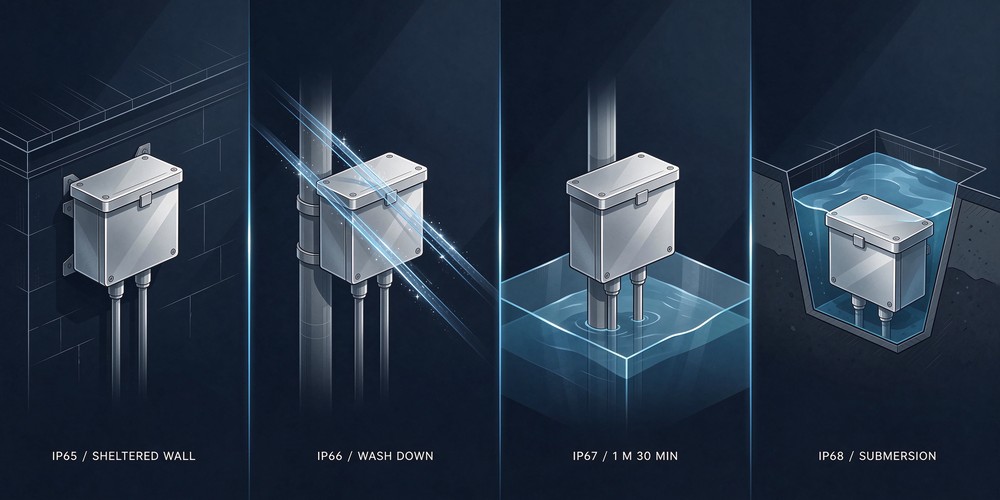
IP codes follow IEC 60529, and the right outdoor rating depends on where the box sits. IP65 is dust-tight and protected against low-pressure water jets from any direction — adequate for a sheltered wall or pole box under eaves. IP66 adds resistance to powerful directed jets, matching exposed farm, industrial, and rooftop installations that face washdown or heavy rain. IP67 covers temporary immersion, one meter for 30 minutes, for boxes that may sit in flood water at the base of a pole or along a curb. IP68 is continuous submersion at a depth and duration agreed with the manufacturer — the rating for underground cable pits, vaults, and flooded sumps. Over-specifying costs gasket weight and cast walls; under-specifying is the common field failure. Compare the levels before ordering: IP65 vs IP67 for outdoor electronics, IP65 vs IP68, and the underground IP68 junction box guide.
UV & Temperature Resistance
Outdoor aging attacks the finish and the gasket, not the aluminum frame. UV exposure is assessed in fluorescent UV chambers per ASTM G154-23; accelerated hours correlate roughly to years of outdoor service, and the visible result on plastic is yellowing, chalking, and brittle edges, while on a coated metal box the first loss is coating adhesion at cut edges. Temperature cycling, specified in IEC 60068-2-14:2023, moves the lid and gasket against the body: differential expansion and internal pressure change pump moisture past a marginal seal, and repeated compression permanently sets an EPDM gasket. Silicone seals cover roughly −60 °C to +200 °C and stay flexible; EPDM runs about −40 °C to +120 °C and is cheaper but sets sooner under constant compression. Design responses for wide swings: keep gasket compression around 20–30% on a dedicated groove, use a breather membrane to equalize pressure without admitting liquid, and specify the seal material to the site's actual winter minimum and summer peak under sun.
Cable Gland Sealing for Outdoor
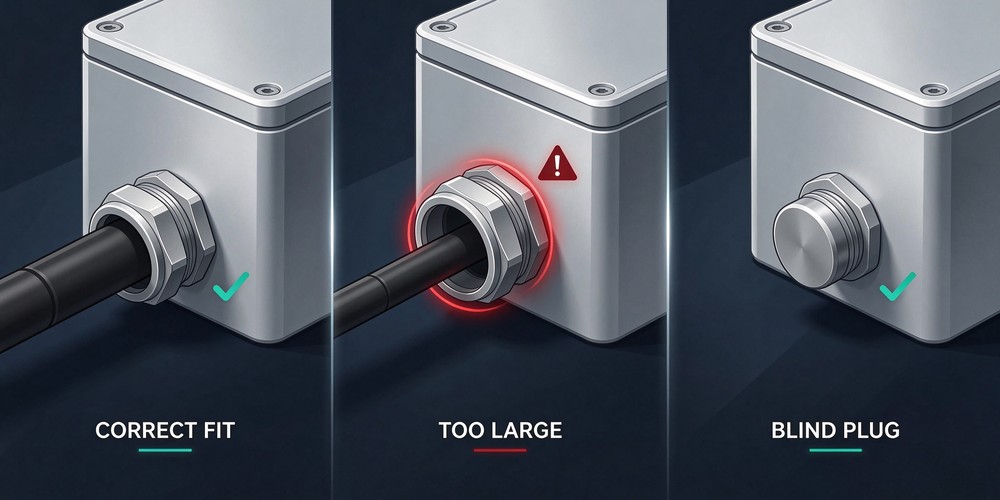
On a junction box, the glands leak before the lid does. Size each gland to the cable's outer diameter: typical M12 covers about 3–6.5 mm, M16 about 4–8 mm, M20 about 6–12 mm, and M25 about 10–17 mm; a gland that is too large cannot compress its seal, and one that is too small will not close. Install the sealing washer against the box face, torque nylon glands to roughly 2–5 N·m, and use thread sealant on metal glands in coastal or washdown service. Close every unused entry with a blind plug — an open hole cannot "breathe" harmlessly outdoors. Run an internal strain-relief loop or cable clip so a pull on the cable does not lever the gland out of its seat, and leave enough bend radius inside the box that splices do not pull against the seal. Multiple small cables should use a multi-hole gland rather than one oversized entry with extra sealant.
Mounting: Wall, Pole, DIN Rail
Three mounting geometries suit outdoor junction boxes, each with its own sealing and load details. Wall mounting uses a standoff spacer so the back face drains and dries; keep the box off the wall face rather than flush-sealing it against a damp surface. Pole mounting clamps with two-point brackets so the box cannot rotate in wind, with the bracket load carried by the body bosses, not the lid. DIN rail mounting is common for terminal blocks inside the box; outdoor rail and screw hardware should be plated or stainless, and the rail itself should be grounded where it carries equipment ground conductors. Regardless of method, tilt the box so water runs off the lid, add a weep hole at the lowest corner if condensation can collect, and leave a service clearance for gasket inspection and gland re-torque. Box sizing for conductors and splices is covered in how to size a junction box.
Grounding & Bonding for Metal Boxes
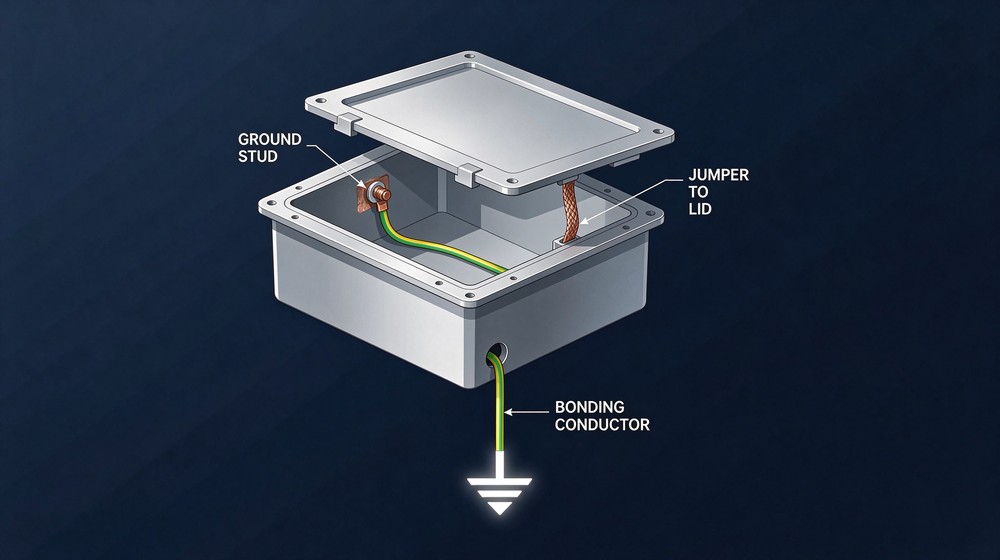
Grounding is the step plastic boxes cannot handle on their own, and it is where a metal outdoor box earns its weight. Under NEC 2023 (NFPA 70) Article 250, conductive enclosures must connect to the equipment grounding conductor for a low-impedance fault-current path; bonding ensures continuity between box, lid, and mounted devices. Practical details on an aluminum box: use a dedicated grounding screw or stud with a plain washer at a clean, unpainted point — anodize or powder coat must be removed at the contact so the metal-to-metal path is real. Bond a hinged or removable lid to the body with a braided jumper, because the hinge alone is not a reliable ground path across gaskets and paint. Mark the ground lug with the ground symbol and size the bonding conductor to NEC Table 250.122 for the overcurrent device ahead of the box. Watch galvanic contact: stainless screws against aluminum in a wet joint can corrode the aluminum, so use plated steel or a dielectric washer where the dissimilar contact cannot be avoided. After assembly, verify continuity with a low-resistance ground bond test; a box that looks metal but reads open at the ground lug fails the intent of Article 250. The NFPA explanation of grounding and bonding requirements is available in the NFPA grounding and bonding guide.
YONGU Outdoor Metal Junction Boxes
YONGU supplies aluminum outdoor junction boxes in profile, split-body, and sheet-metal forms, sealed to IP65 through IP68 with anodized or painted finishes. The L04C outdoor waterproof case (130 × 100 mm) and L01B small IP68 junction box (100 × 75 mm) cover compact wall and pole splices; the extruded J24 outdoor junction box (84 × 28 mm) suits slim profile runs. The full range is listed in the waterproof junction box category, alongside aluminum electronics enclosures and sheet-metal enclosures. Cutouts, gland holes, grounding bosses, and finishes are customized to the cable plan; MOQ starts at one unit, samples ship in about 5–7 working days, and IP and salt-spray reports are available for review.
Send the cable plan and mounting site, not just a box size. Share the cable count and diameters, ambient temperature range, whether the box sees washdown or standing water, and any grounding requirement, and YONGU will match an aluminum junction box, specify gland sizes and gasket material, and confirm the finish for your climate. Start through the contact page; reports and drawings are on the downloads page.
FAQs
What is the best metal for an outdoor junction box?
Aluminum is standard: light, rigid, anodizable. Choose 6063 extrusion for profile boxes, 6061 for higher strength, and 5052 sheet for coastal panels. Stainless lasts longer but costs and weighs more; painted steel suits mild inland climates with a protected finish.
Should an outdoor junction box be IP65, IP66, IP67, or IP68?
IP65 for sheltered eaves or wall boxes; IP66 for exposed rain, washdown, and rooftop duty; IP67 for locations that may flood temporarily; IP68 for underground pits or continuous submersion. Match the rating to the actual water exposure rather than buying the highest code by default.
Do metal junction boxes need to be grounded?
Yes. Conductive enclosures in U.S. installations must be bonded to the equipment grounding conductor under NEC Article 250, with a clean metal contact at the ground lug and a jumper to any hinged lid. Verify the bond with a low-resistance continuity test after assembly.
Can a plastic outdoor junction box be grounded?
The plastic body cannot carry ground continuity; add an internal grounding bar bonded to the equipment ground, and choose UV-stabilized polycarbonate outdoors. A metal enclosure is the simpler solution where the box itself must be bonded or shielded.
How do I prevent corrosion on an aluminum outdoor junction box?
Sealed anodizing or conversion-coated powder protects the body; use plated or stainless fasteners, seal glands and cut edges, and avoid bare dissimilar contact in wet joints. Coastal sites should specify 5052 or Type III hard anodize and review salt-spray reports first.
How many cable glands can an outdoor junction box take?
It depends on internal splice space and gland size, but the rule is one matched gland per cable, blind plugs for spare entries, and enough internal bend radius that cables do not stress the seal. Send the cable list so the cutout layout and box size are set together; sizing guidance is in the junction box sizing guide.